


Clinical Reasoning Through Evolutionary Explanation
Using allostatic load to integrate nutrition and lifestyle medicine.
You already know the interventions. Ninety minutes on the harder question: which one first, and why that one.
Two questions, one patient
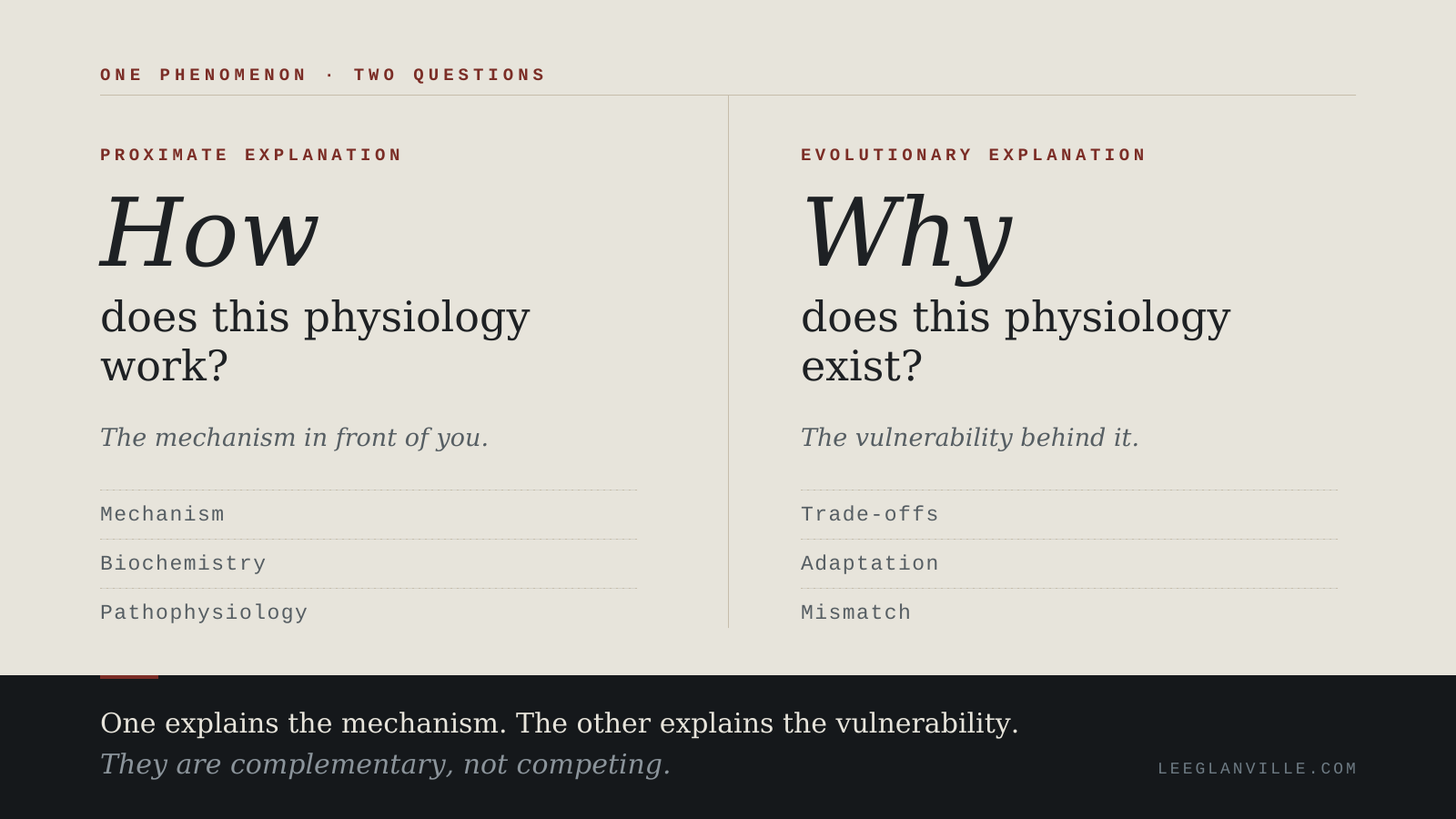
Proximate explanation asks: how does this physiology work? Mechanism, biochemistry, pathophysiology, neuroendocrinology.
Evolutionary explanation asks: why does this physiology exist? Trade-offs, adaptation, mismatch, constraint.
One phenomenon. Two valid questions. One explains the mechanism, the other explains the vulnerability — and they are complementary, not competing.
The gap is rarely knowledge. It is sequence.
Most practitioners already have nutrition, sleep, movement, stress, behaviour change and functional assessment. Faced with a complex case, the question is almost never what intervention exists. It is:
Which intervention first? Why that one? What is generating the greatest physiological load? What will this actually cost the patient to do?
This lecture teaches reasoning, not another intervention. Nothing in it asks you to abandon the model you already work in.
Thirteen layers, read top down
Each concept rests on the one above it. The lecture works through them in order, and the whole sequence resolves into a single clinical question you can ask in a consultation.
Evolution by natural selection — Health is not the objective. Adaptation is. Selection produces trade-offs, constraints and compromise.
Human behavioural ecology — Finite resources, continuously allocated. Every choice carries an opportunity cost, including every choice you prescribe.
Tinbergen's questions — Different questions generate different explanations. This is the hinge the rest of the reasoning turns on.
Evolutionary medicine — Explains why we are vulnerable to disease. Its contribution is explanatory, not therapeutic, and saying so clearly is what makes it useful.
Evolutionary mismatch — Modern environments differ from those that shaped human physiology. One important explanation for why demand persists.
Allostasis — Physiology continually adapts. Adaptation itself is normal, and reading it as pathology is a common clinical error.
Allostatic load — When adaptation becomes chronic, cost accumulates. This is the organising concept that links explanation to decision.
Clinical observation — History, timeline, matrix, symptoms, lifestyle, biomarkers. Use the tools you already have, but for observation only, not yet for prioritisation.
Explanation, both kinds — How is this physiology operating, and why is it behaving this way. Asked deliberately, in that order, on the same case.
Clinical reasoning — Which contributors generate the greatest load. Which are most amenable to change. Where benefit is highest and cost is lowest.
Total intervention cost — Biological, behavioural, psychological, social and perceived. Motivational interviewing is not only behaviour change; it lowers the cost of doing the thing.
Lifestyle medicine — Nutrition, sleep, movement, stress, environment, relationships, recovery. The intervention follows the reasoning, rather than leading it.
Reflection — Has physiological load reduced? Has resilience improved? What did the case teach you? Then repeat.
You will also be asked to run the sequence on yourself. Clinicians who can locate their own load read it more accurately in other people.
By the end, you will be able to:
Distinguish proximate from evolutionary explanation, and say why a case needs both.
Describe allostatic load as a framework for cumulative physiological demand.
Use allostatic load to prioritise between interventions you already know.
Estimate the total cost of an intervention before you recommend it.
Apply the same reasoning to your own physiology, and to your patients'.
Who it's for
Nutritional therapists and registered nutritionists. Functional medicine practitioners. GPs and clinicians working in lifestyle medicine. Osteopaths, chiropractors and allied health professionals. Students in their final year of an accredited programme.
What it is not
Not a new biological theory. Not a protocol, and not a supplement list. Not a replacement for the model you already use. Not a case for eating like a hunter-gatherer. Not a system that ranks interventions for you.
The lecture teaches explanatory frameworks and leaves the judgement with the clinician. That boundary is deliberate.
Who is teaching it
I came to this from biological anthropology rather than from clinical practice, and spent years in functional medicine noticing the same thing: we are very good at explaining how physiology works, and much less practised at explaining why it is behaving that way in front of us.
This lecture is the shortest useful version of that argument. It draws on evolutionary medicine, human behavioural ecology, allostatic load and motivational interviewing — none of it new, all of it established — and assembles it into something you can actually use on a Tuesday afternoon with a complicated patient.
Lee Glanville. BSc (Hons) Biological Anthropology. MSc Nutrition & Lifestyle Medicine (in progress). AFMCP and PRCFMP, Institute for Functional Medicine.
Bring it to your team
The lecture works best with a room that already shares a clinical vocabulary — a practice team, a regional group, a cohort. I deliver it in person across the UK and online, and I'll tune the worked examples to the cases your people actually see.
90 minutes, including discussion and a live worked case. 60 minutes condensed for conference and event slots. Half day extended, with participants bringing their own cases to sequence. In person or online, groups of roughly 8 to 60.
Booked by clinic and practice teams, professional association regional groups, nutrition and integrative medicine training providers, university programmes, and conference organisers.
Tell me who's in the room and what they're stuck on, and I'll tell you honestly whether this is the right lecture for them.
First dates go to this list
The lecture is being delivered to small groups first, so I can teach it properly before it scales. Add your details and I'll write to you once with dates. Nothing else.
Email me when dates are announced. I can unsubscribe at any time, and my details won't be shared.
Join the waiting list — Expect one email about dates, and nothing in between.